

Sculpting the Purebred Arabian Horse
Arabian horse
5 Surprising Truths About Sculpting the Purebred Arabian Horse
The Arabian horse is more than a biological specimen; it is a living testament to a "calm power" that has captivated the human imagination for millennia. For sculptor Abdulbaset Sallal, translating this majesty into three dimensions is far more than a technical exercise in replication. He describes his artistic mission as a spiritual endeavor to "engrave beauty and loftiness" into his chosen media. In the world of high equestrian art, the Arabian horse represents a unique dichotomy of form—a bridge between the visceral strength of the desert warhorse and the ethereal grace of a moving masterpiece. To appreciate these works is to understand a silent language spoken through meticulous anatomical nuance and profound symbolic depth.
1. The "Identity Card" is Written in the Face
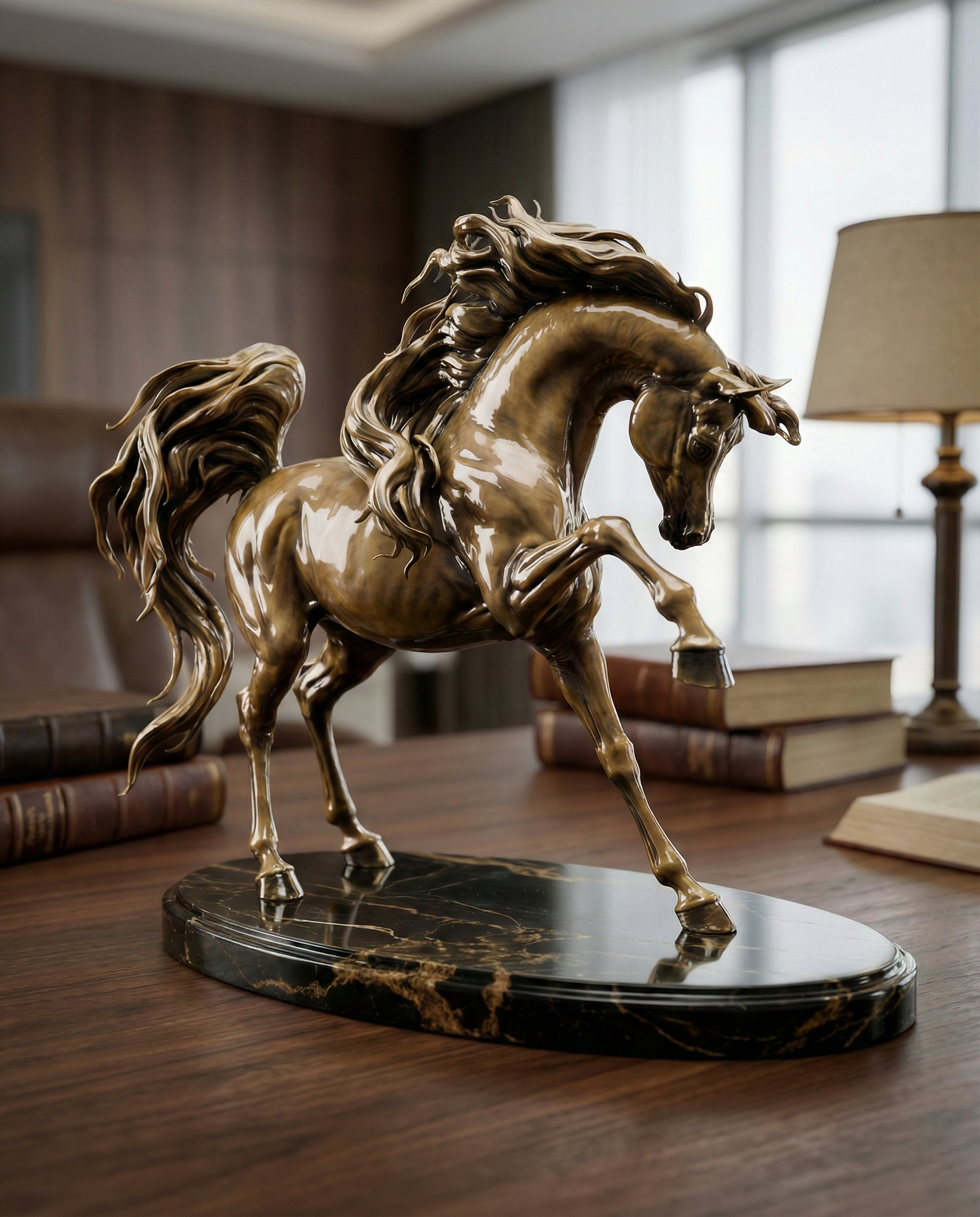
In the specialized lexicon of equestrian sculpture, the head of the Arabian horse is its definitive "identity card." It is here that the sculptor must achieve absolute anatomical precision to convey the breed’s nobility. Authenticity requires a master’s touch on the "dished face"—the hallmark concave profile—and the wide, intelligent eyes that mirror the spirit within. However, the true "Secret of Identity" lies in even finer details: the wide, flared nostrils and the smooth, refined jawline (الفك الناعم).
As Abdulbaset Sallal notes when discussing this vital focal point:
"The creative sculptor embodies intelligence, pride, and tenderness through the expressions of the eyes, the position of the ears, and the curvature of the neck."
Capturing these minute expressions is the most grueling aspect of the process. It is the moment where the artist moves beyond mere bone and muscle to reveal a living personality, manifesting the horse’s inherent pride through the delicate balance of the facial features.
2. The Raised Tail: A Non-Negotiable Signature of Vitality
One cannot discuss the Arabian horse without acknowledging the "naturally raised tail," a feature that serves as a non-negotiable signature in the world of professional sculpture. More than a decorative flourish, the high carriage of the tail is a "sign of quality and authenticity" that announces the animal's vitality and power. In a static sculpture, the tail is the primary engine of energy; it is a declaration of pride that distinguishes a high-quality breed-specific work from a generic equine representation. A master sculptor uses this feature to create a sense of momentum, ensuring that even a stationary bronze appears to be surging with life.
3. Grace vs. Mass: A Dichotomy of Form
There exists a profound aesthetic gulf between the sculpting of European breeds and the Purebred Arabian. Where European breed sculptures often lean into "muscular titanism" and raw, heavy power, the Arabian aesthetic is defined by "calligraphic fluidity" and slender, flowing lines.
The artist’s approach to musculature must be paradoxical: the muscles must be prominent enough to showcase strength, yet remain "soft and harmonious" to avoid the appearance of exaggerated bulk. Central to this silhouette is the "Elegant Arch" of the neck, a symbol of pride and nobility that provides the sculpture's rhythmic center. Furthermore, while traditional Bedouin saddles and bridles add a rich heritage character to a piece, Sallal notes that "naked" or bare sculptures are often the pinnacle of the art form. The absence of tack allows the unadulterated beauty of the horse’s refined anatomy to remain the singular focus of the viewer.
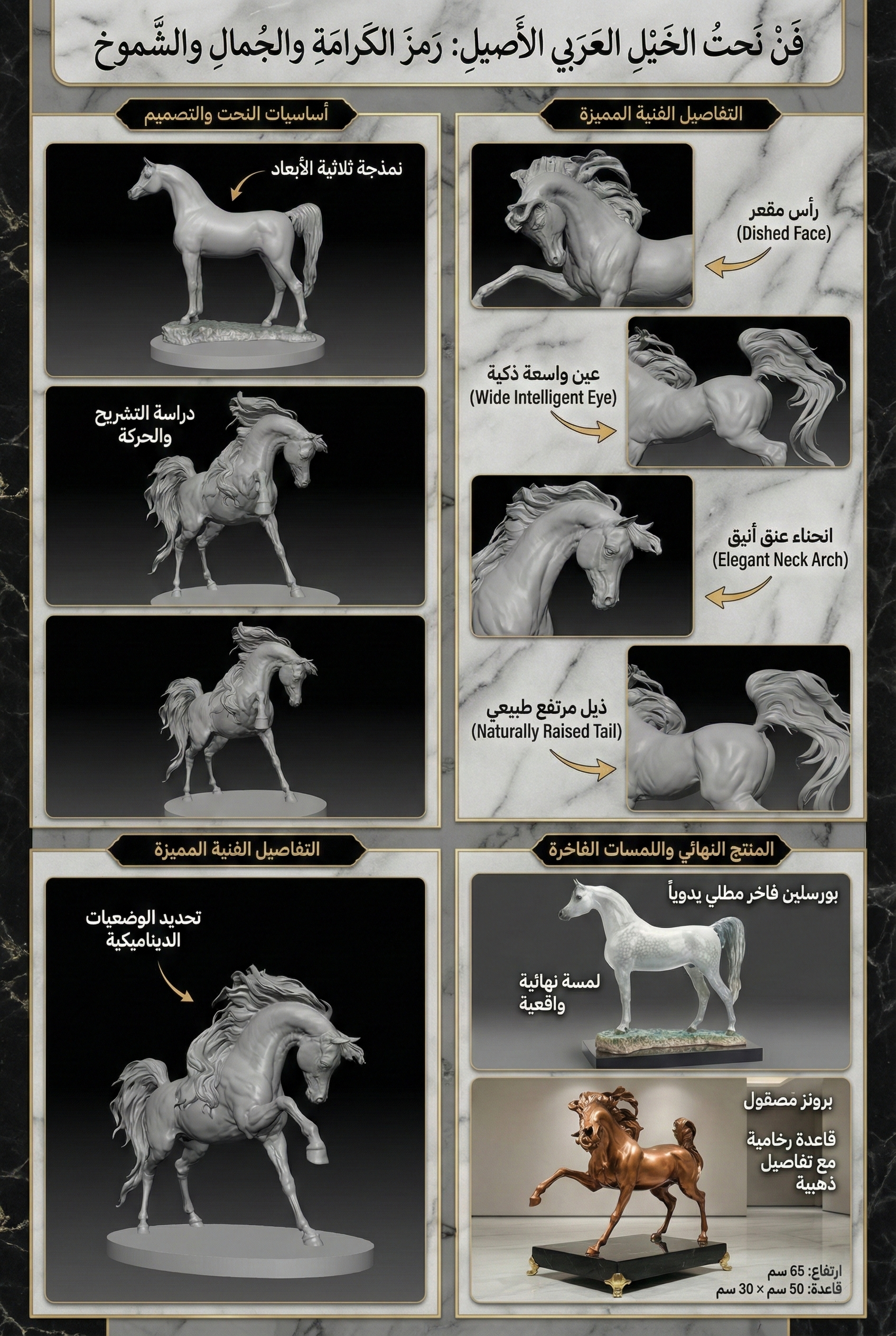
4. Material Intelligence: From Digital Foundations to Dark Luxury
The transition from a concept to a physical monument is a journey through "Material Intelligence." Modern high-precision sculpture often begins with 3D modeling—a "digital foundation" that allows the artist to perfect the anatomical precision and the delicate balance of the legs, which is the most challenging technical feat in equestrian art.
• Bronze: The premier choice for luxury, particularly for indoor settings. While gold, silver, and ivory white finishes are common, natural bronze and shiny black are considered the pinnacle of prestige and "luxury" in the collector’s world.
• Fiberglass: The preferred medium for life-sized outdoor monuments, such as those gracing the public squares and elite farms of Saudi Arabia, the UAE, and Egypt. It is prized for its high resistance to desert weather and its impressive strength-to-weight ratio.
• Diverse Media: To meet the varied needs of curators, Sallal also works in crystal, marble, high-quality resin, hand-carved wood, and fine ceramics, ensuring the piece harmonizes perfectly with its intended environment.
5. Dynamics of Motion: The Spirit of the Desert Warhorse
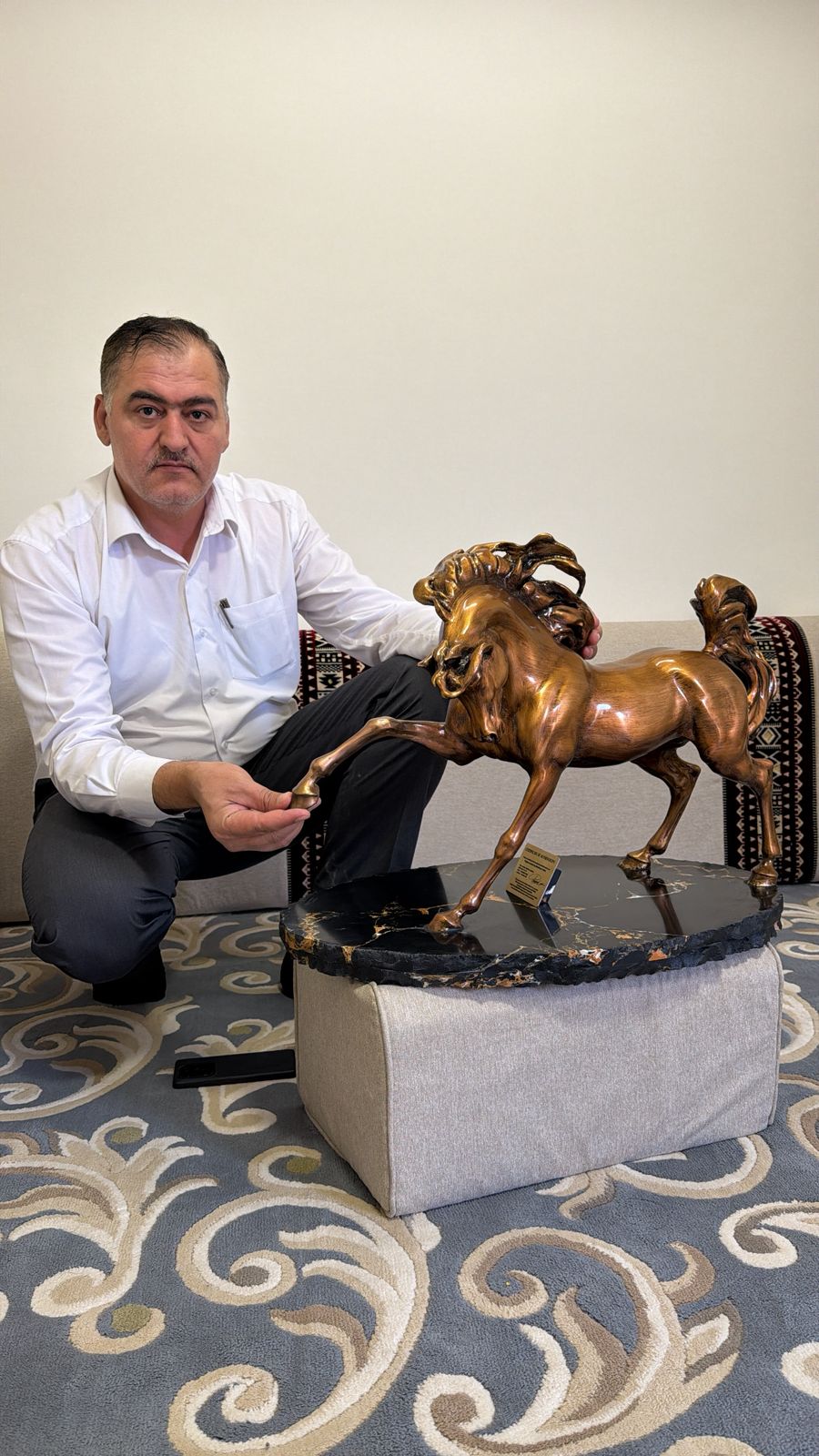
While the Arabian horse is often sculpted "standing with pride" or in "high grazing" poses, the most sought-after works are those capturing dynamic motion: leaping, running, or galloping with the head raised. These poses are not merely aesthetic choices; they are a tribute to the horse’s historical role as a desert warhorse.
The "spirit and vitality" of the breed are best expressed through these movements, which showcase the animal's agility and historical heritage. Choosing a pose is also an exercise in environmental curation; the collector must decide if the setting calls for the royal dignity of a stationary pose or the kinetic energy of a horse in flight. As Sallal emphasizes, the horse remains a "living symbol of dignity," and dynamic sculpture allows that dignity to be frozen in a moment of peak physical and spiritual power.
.jpg "About Sculpting the Purebred Arabian Horse")
--------------------------------------------------------------------------------
These sculptures bridge the gap between two distinct worlds: the "classical anatomical school," which demands strict adherence to biological realism, and the "modern simplified style," which treats the horse as a streamlined cultural icon. Ultimately, to own such a piece is to possess a fragment of Bedouin heritage in its most refined form, translated through the meticulous interplay of the head, neck, and tail.
In an age defined by digital perfection, does the physical curvature of a bronze horse still hold the power to move the human spirit? The enduring demand for these tactile, majestic forms suggests that the silent language of the Arabian horse—of beauty, loftiness, and pride—is a timeless dialect that continues to resonate with the soul.